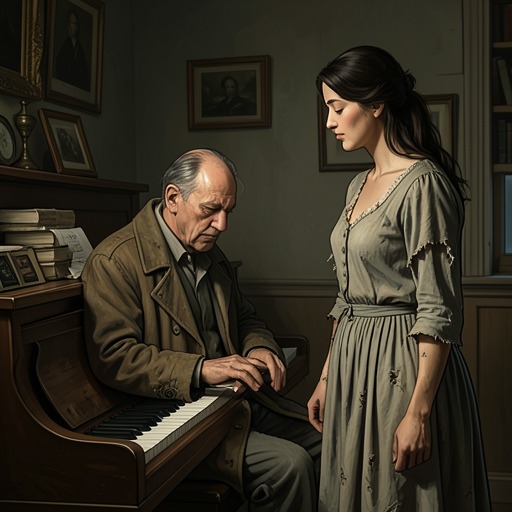
The Disfigured Pilot and the Maid Rekindle Their Love After the Illusion Fades
Kiss of the Spider WomanThe Disfigured Pilot and the Maid Rekindle Their Love After the Illusion Fades is an embedded film story told by Molina to Valentin. A pilot whose appearance has changed after war and a maid who has long believed herself unattractive find companionship, marry, and experience a brief transformation in how they see each other. When that enchantment collapses in front of the pilot’s parents, the couple retreat from one another; a blind composer and the housekeeper help them recognize that their renewed love rests not on altered faces but on a shared apprehension of each other’s inner selves.
The Maid, the Pilot, and Their Unequal Losses
The story opens in winter, with the maid permitted to remain in the house because she has nowhere else to go. The housekeeper and maid share sadness, though the housekeeper recognizes that companionship can sometimes make sorrow harder to bear. Even so, their limited means allow them to share a can of soup. The scene establishes the maid’s precarious position and the emotional isolation against which the romance develops.
The pilot arrives after battle, his former face changed by a scar and his military career ended by both injury and a nervous collapse. The maid, who remembers him as handsome and spirited, rushes to welcome him, only to show her shock at his appearance. His own distress takes the form of sharpness toward her: he asks to be left alone and insists that she avoid making noise. The meeting therefore begins not with mutual consolation but with a collision between her old image of him and his present appearance, and between his dependence on the household and his wish to withdraw from other people.
The pilot’s parents and fiancée visit, but he refuses to see them. The fiancée pleads to be admitted and says that the accident does not matter to her, but the story presents her words as insincere; she leaves abruptly. Meanwhile, the pilot spends his time drawing. As spring arrives, the maid brings coffee and doughnuts to him in the forest, where he works outdoors. The narrated account marks a remark she makes about one of his drawings as the moment he recognizes her refined sensibility, though Molina cannot recall the words themselves. A remembered exchange, rather than a change in either person’s looks, begins to alter their relationship.
A Marriage Made as Companionship
A blind composer also becomes important to the couple’s approach to one another. His account of gradually coming to terms with his blindness offers the pilot a model of living with loss, while his presence gives the story a perspective that is not governed by ordinary sight. The pilot proposes marriage to the maid as an arrangement between two lonely people: he can provide financial security, and she can care for him. He presents the offer as companionship without a promise of love, acknowledging their shared isolation rather than pretending that either is already happy.
The wedding is small and solemn. The blind composer and the housekeeper serve as witnesses in a wooden church, where candles burn and the benches and choir loft are empty. Afterward, the housekeeper has prepared a supper for two. The couple sit in silence, unable to look at each other. Their marriage has changed their practical circumstances, but it has not yet made intimacy easy; the meal holds them in the uncertain interval between a proposed contract and a relationship they have not learned how to inhabit.
The Enchantment and Its Collapse
During the supper, the couple’s perception seems to shift. The house and the faces before them become indistinct, and the maid appears beautiful while the pilot seems handsome again. They look into one another’s eyes, join hands, and kiss. In the days that follow, they fear that the experience may have been a dream and hide from the housekeeper, meeting in the forest before dawn instead. When the blind composer encounters them there, he senses that something has changed and greets them without seeing them.
The couple’s happiness is tested when the pilot invites his parents to visit, believing himself nearly recovered. The parents arrive expecting to find their son well, but they see his scar and a bride whom they judge by her appearance and social position. Their disappointment unsettles the couple. The maid looks in a mirror and sees her familiar face; the pilot stands beside her, and each becomes conscious again of what the other looks like. They retreat into darkness, avoid one another, and the maid returns to her former room. The pilot destroys his self-portrait, turning the collapse of the shared illusion into a visible act of despair.
Seeing Beyond Appearance
The housekeeper summons the blind composer, who visits at autumn twilight. With the lights off, he speaks to the couple about their recent concealment from each other. He explains that love had allowed them to see each other’s souls rather than their bodies, and asks them to look at one another again without doubt. His intervention reframes the earlier enchantment: it need not mean that their appearances literally changed. It can instead describe a way of seeing made possible by love, one that the couple had briefly experienced and then lost confidence in.
The housekeeper reinforces this understanding while helping the maid prepare for supper. She recalls that her own fiancé never returned from the trenches in France, and says she believes he would still find her beautiful because he died loving her. Her recollection gives her encouragement a personal history: she too measures beauty through the persistence of love, not through another person’s present appearance. At the window, the pilot takes the maid’s hand, removes her ring, and writes their names in the glass. They kiss again, this time after the blind composer and housekeeper have helped them face the truth of what they see.
Molina’s Retelling and Its Frame
The ending returns attention to the act of storytelling. Two additional guests arrive on tiptoe, seen from behind and dressed elegantly; the listeners are not told whether they are the pilot and the maid, and their faces remain unavailable to judgment. The story thus closes without certifying that the couple’s appearance has been transformed again. Instead, it leaves the question of recognition with the audience and makes the couple’s identity depend on their shared history rather than on visible proof.
Molina tells Valentin that his mother loved the story and that he did too. He then decides not to share more of the films he likes, because Valentin has mocked what he considers his softness. That response gives the embedded romance a second consequence outside the film’s plot: the story exposes Molina’s vulnerability, but also prompts him to keep part of his inner life private. Its account of people learning to see beyond appearances consequently resonates with the unequal closeness between the two prisoners, even as Molina chooses not to explain the connection aloud.